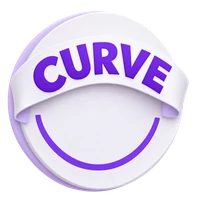
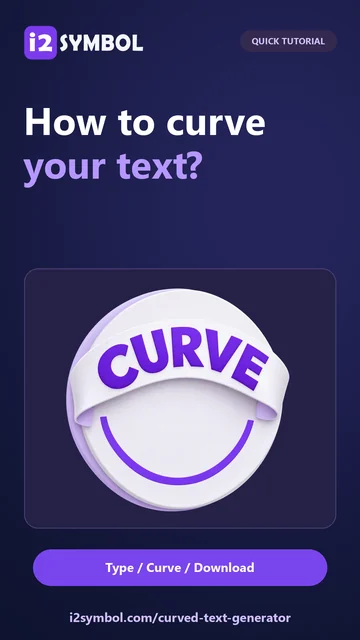
Shape your words into an arc or circle. Adjust the lettering and finish, then download an image for your design.
Your curved text will appear here.
Updating preview…
Curved text is an image. Use PNG for a transparent background, or a project file to keep the design editable.
Quick styles
How to Make Curved Text
01
Enter your text
Type a single line of text. Choose a font that supports your characters and check the lettering in the preview.
02
Set the curve
Choose Arch up, Arch down, Circle or Straight, then refine Curve, Rotation and Letter spacing in Settings.
03
Style the lettering
Choose the Font, Text size and colors, then add an outline or Soft shadow. Quick styles give you a starting point while keeping your own words.
04
Download or save
Download PNG for a transparent design or JPG with a background. Use Save project for a browser copy, or Save options and Download project for an editable JSON file.
Shape Your Words into an Arc or Circle
Create curved lettering for a label, heading or graphic. Enter your words, adjust the bend and style, then download a rendered image or save the settings to edit again.
Enter your words, shape the lettering, then download the finished image.
Control the bend and rotation to place your words around the shape you need.
Understand curve direction and spacing
Curve ranges from -360 to 360 degrees. Positive values make an upward arch, negative values bend downward, and zero makes straight text. Circle arranges the lettering around a near-full turn with a small gap at the seam. Rotation turns the complete arrangement around its center.
Letter spacing uses the browser's text-spacing support. Connected scripts may keep their native joining behavior, and a browser without this support reports that the setting is ignored. Longer words, wider spacing and stronger curves can produce crowded lettering, so check the preview after changes.
Very short text can have its curve softened to avoid folding the artwork; the tool reports this adjustment. A short word or letter may therefore look less curved than the selected angle suggests.
Choose lettering that fits your words
Keep your text editable while choosing a font and size that suit the design.
Check characters, fonts and readability
Enter one line, up to 120 grapheme clusters and 1,000 UTF-16 units. A visible character can contain several Unicode units, so emoji and combined characters may reach a limit sooner than simple Latin letters. Unsupported line breaks or an over-limit entry are reported so you can revise the text.
Choose one of eight included Font options and set Text size from 24 to 160 pixels. Bold and Italic adjust the lettering. Use Load system fonts when your browser supports it and you grant access. Font availability and character coverage differ by device. Select a font with the characters you need and review the design before downloading.
The browser first shapes the complete text, then the tool bends that rendered line as an image. Arabic joins, combining marks and emoji are not positioned as disconnected characters. The bend still changes glyph shapes, so use a gentler curve or straight text when that gives a clearer result.
Build a clear text style
Set the text color, add an outline or shadow, and start from a style preset.
Combine color and finishing controls
Text fill sets the main lettering color. Outline adds an edge around the letters, and shadow adds separation from the background. Choose enough contrast for the place where you plan to use the image.
The eight Quick styles change appearance settings while preserving your words, Image width and Padding. They are starting points: adjust the font, curve and finishing controls to match your own heading or label. Reset style returns the settings to their defaults while keeping your text; New starts an empty design.
Prepare the size and background
Choose the output size and check the finished lettering against its background.
Understand preview and image dimensions
Canvas & export includes Image width from 400 to 2,400 pixels and Padding around the design. Height is calculated automatically, up to 2,400 pixels. If needed, the complete artwork is reduced to fit and the tool reports that adjustment. The preview fits your screen; it is not shown at the downloaded pixel size.
Transparent PNG keeps the area around the letters clear for placement over another image. Use a solid background when you want a complete rectangular graphic. JPG does not support transparency and uses the selected background color.
Download curved lettering as an image
Choose PNG or JPG to keep the arrangement shown in the preview.
Choose an image or editable project file
PNG and JPG are rendered images of the text. The curve, colors and effects are part of that image; they are not formatting that can be pasted into an ordinary text field. Copy image places a PNG on the clipboard when your browser supports image copying. Paste it into an app that accepts images, or use Download if copying is unavailable.
Choose Save options and Download project to keep an editable .i2curve.json file. Use Open project, then Open project file to load it again. This project is separate from the finished PNG or JPG and contains text and settings, not image or installed-font files. Another device may need the same font to reproduce the design.
Return to an editable design
Explicitly save a named design locally, or load a JSON project to continue editing.
Understand local saves and project privacy
Save project keeps up to 50 named projects with their text and settings in this browser. Saving an opened project updates it; Save a copy creates a separate entry. Open project lets you reopen or remove saved work. Importing a project file does not add a browser save until you choose Save project.
Saving is explicit; typing or changing a control does not create an automatic saved draft. Browser projects are not account-synced. Clearing site data removes them, and other people using the same browser profile may be able to open them. If browser storage is unavailable, the tool reports that projects are kept only for this visit; download a project backup to retain them.
Your text, images and editable projects
Text layout and image rendering take place in your browser. PNG and JPG keep the finished appearance; saved designs and JSON project files retain editable text and settings.
Only an explicit save stores a local design. System-font access, where supported, is requested through your browser. Font files are not included in an exported project. Use 3D Text Generator for depth effects, or Text to Image for a larger text layout.
FAQ
Good to know.
A few answers before you get started.
What does Curved Text Generator do?
It arranges a line of text into an arc, circle or straight design. You can adjust the font, spacing, rotation, colors and effects, then download a PNG or JPG or keep an editable design.
Can I make upward, downward and circular text?
Yes. Use Arch up or Arch down for opposite curve directions, Straight for zero bend, or Circle for circular lettering with a seam gap. Refine Curve, Rotation and Text size in the preview. Very short text can have its curve softened to prevent folding.
Can I download curved text with a transparent background?
Yes. Choose a transparent background and download PNG. JPG does not preserve transparency and uses the selected background color. The downloaded image keeps the curved arrangement.
Can I copy the curve into a normal text field?
No. Ordinary text does not carry this curved layout. Copy image can place a PNG on the clipboard in a supported browser, or you can download PNG or JPG for use where images are accepted. Keep a saved project or JSON file to edit the text and settings later.
Which characters and fonts can I use?
The editor accepts a single line up to 120 grapheme clusters and 1,000 UTF-16 units. Choose a font that covers your characters. The browser shapes the complete line before it is bent as an image, keeping joined text and emoji together. Bending still changes letter shapes, so inspect the preview and use a gentler curve when needed.
Can I use fonts installed on my computer?
The system-font option works when your browser supports local-font access and you grant permission. Availability varies by browser. Project files store font settings rather than font files, so another device may need the same font installed.
What is the difference between Save and a JSON project?
Save project keeps up to 50 named editable projects in this browser. Saving an opened project updates it; Save a copy makes another entry. Download project creates a separate JSON file that Open project file can load later. Browser saves are not account-synced and are removed when site data is cleared.
Is my text saved automatically?
No. Editing does not create an automatic saved draft. Save explicitly to keep a browser design, or download an image or JSON project. Other people using the same browser profile may be able to access browser-saved designs.